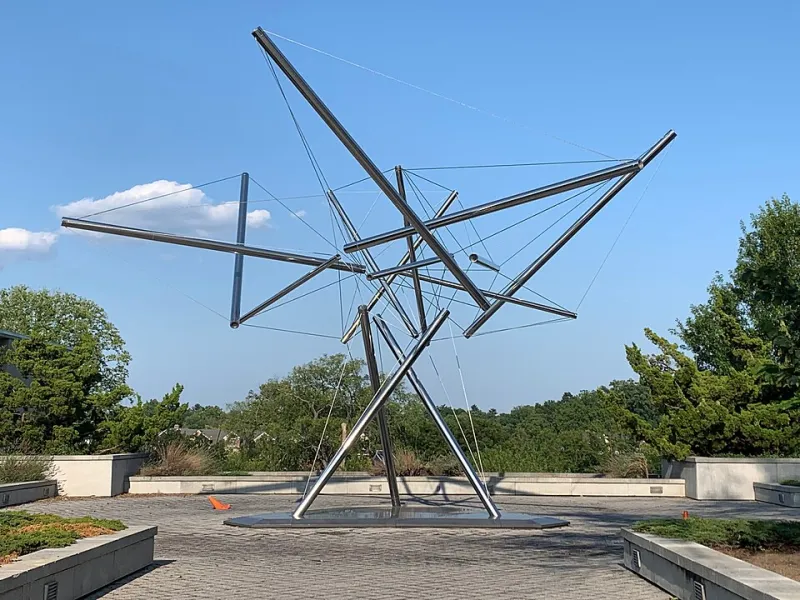
Cables in the Quiet Room: A Gallery-Goer’s Guide to Tensegrity Sculpture
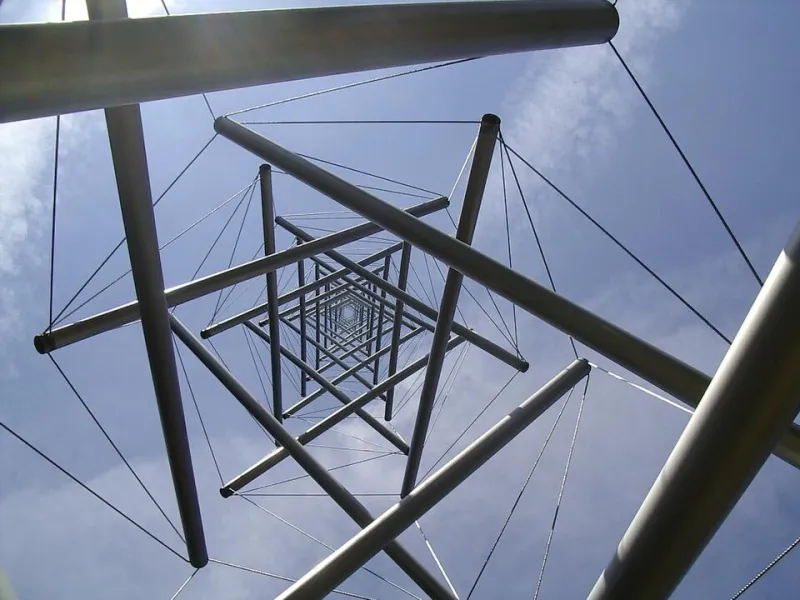
Photo: Staka, CC BY-SA 4.0, via Wikimedia Commons
Galleries are good at teaching us how to look at paintings; less good at teaching us how to look at a structure that seems to disobey gravity. Tensegrity sculpture often sits in that gap. It can look like a maquette that escaped from an engineer’s studio, or a delicate drawing made in three dimensions. The reward comes when you stop trying to solve it in ten seconds.
What to look for when you enter the room
Start with the edges of the work, not the centre. Where does it meet the floor, the ceiling or the wall? Are there cables running to anchors? Does the piece stand on a plinth, or is it suspended? Tensegrity works are often more connected to the room than they first appear. The anchor points are part of the sculpture, even when they are just small plates or hooks.
Then look at the shadows. Cables cast thin lines; struts cast thicker ones. A slight change in your position can reveal a cable that was invisible a moment ago. This is one reason tensegrity rewards slow looking: the work is a drawing in space, and your viewpoint keeps redrawing it.
Fragile and firm at the same time
A tensegrity sculpture can feel precarious without being unstable. The cables are in tension; the struts are in compression. The form is held by prestress, which means the members are already pulling and pushing against each other before anyone leans on the work. The result is a strange combination of lightness and rigidity. It looks as if it might drift apart, but it is held by a system.
Artists use that feeling. A tensegrity piece can be a metaphor for interdependence, balance or tension without collapse. It can also be a purely visual pleasure: rods that seem to float, cables that draw curves in the air, joints that look too small for the job. The best works do not ask you to admire the engineering alone. They ask you to notice how the engineering changes the way the form feels.
How artists use cables and compression
Some artists make the cables almost disappear. They use thin steel or transparent line so that the struts appear to hover. Others make a feature of the connections: bright turnbuckles, polished nodes, visible swages. Some use elastic to introduce movement; others use low-stretch cable to keep the form crisp.
Compression members can be almost anything: timber, aluminium, acrylic, found objects. The choice matters. A mirrored strut reflects the room and makes the work feel less solid. A rough timber strut makes the same geometry feel handmade. If the piece is painted a single colour, the structure may read as a single drawing. If the cables are a different colour, your eye starts to separate the tension network from the compression.
Ask whether the tension is real. A work can quote the look of tensegrity while relying on a hidden frame, a rigid joint or a clever bracket. That is not necessarily a con. Art is allowed to use theatre. But it is worth knowing what you are looking at.
A short glossary for the gallery
- Compression member: a strut or rod that is being squeezed.
- Tension member: a cable, cord or tendon that is being pulled.
- Node: a point where members meet. In tensegrity, nodes are where the load paths change direction.
- Prestress: the internal tension and compression built into a structure before it carries any extra load.
- Self-stress: a state where the members hold each other in equilibrium without external load.
- Load path: the route a force takes through the structure.
- Floating compression: the visual effect of compression members held apart by a tension network.
- Anchor: the point where the work is tied to the floor, wall or ceiling.
Questions to ask in front of a work
Where does the weight go? Which parts are pushing, and which are pulling? Are the cables structural, or are they just suspending the object? Does anything touch that should not? Is there a hidden support, a central post or a rigid frame? What would happen if one cable were slackened? How does the work use the room? Why these materials? Does it change as I move around it?
You do not need to answer every question. The point is to look with purpose. A gallery invigilator may have a room sheet or artist notes; it is always worth asking. If there is a label, read it twice: once before you look and once after. The second reading is usually more useful.
Tips for spotting tension-based art in UK collections and shows
Look beyond dedicated sculpture galleries. Tensegrity ideas turn up in design museums, architecture displays, kinetic art, and temporary commissions. The V&A, the Design Museum, Tate Modern, the Hayward Gallery, Baltic, Ikon and the Fruitmarket are all worth watching, though not every show will include a true tensegrity work. Degree shows are often good hunting grounds: students in sculpture, product design and architecture use cables and struts because they are cheap, dramatic and structurally honest.
At a temporary exhibition, check the ceiling first. Suspended works often reveal their cables only when you stand directly underneath. At a sculpture park or public commission, walk a full circle before deciding how the piece works. The view that makes it look impossible is usually not the view that explains it.
And if you see a work by Kenneth Snelson, Buckminster Fuller or a contemporary maker who cites them, give it time. Tensegrity sculpture is not a puzzle to be solved and left behind. It is a lesson in looking at forces you cannot see.