Stop Calling It a Miracle: An Honest Reader's Guide to Tensegrity Claims
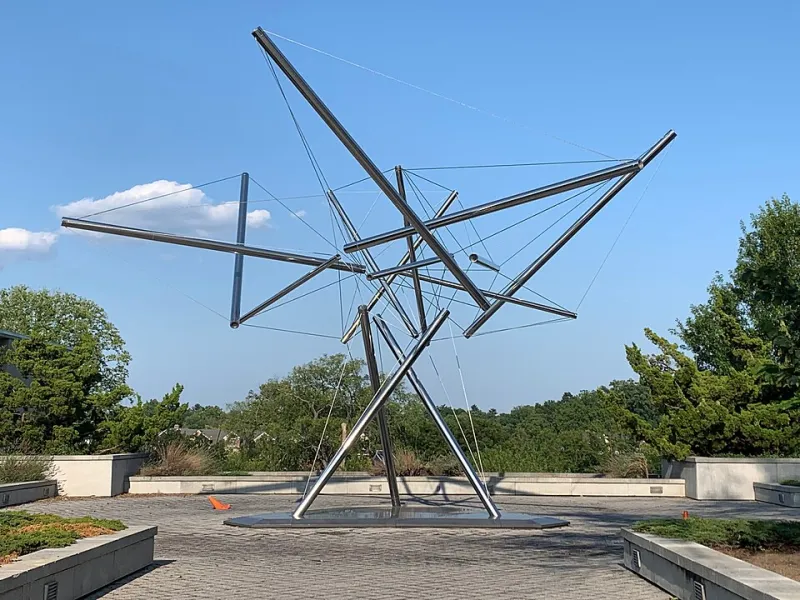
Photo: Danski14, CC BY-SA 4.0, via Wikimedia Commons
Tensegrity has a public relations problem, and it is not the structures' fault. The word turns up in planning documents, gallery labels and maker videos with the confident glow of a solution to everything: houses, footbridges, festival stages, public art, maybe the wobbly shelf in your kitchen. It is a lovely word. It sounds like tension and integrity shook hands and agreed to hold something up together.
But a tensegrity table is a lovely thing. A tensegrity footbridge is a serious engineering proposition. A tensegrity house is, in most ordinary circumstances, a category error. The sooner UK makers, marketers and public-art commissioners get comfortable saying that out loud, the better the work will be.
What tensegrity actually promises
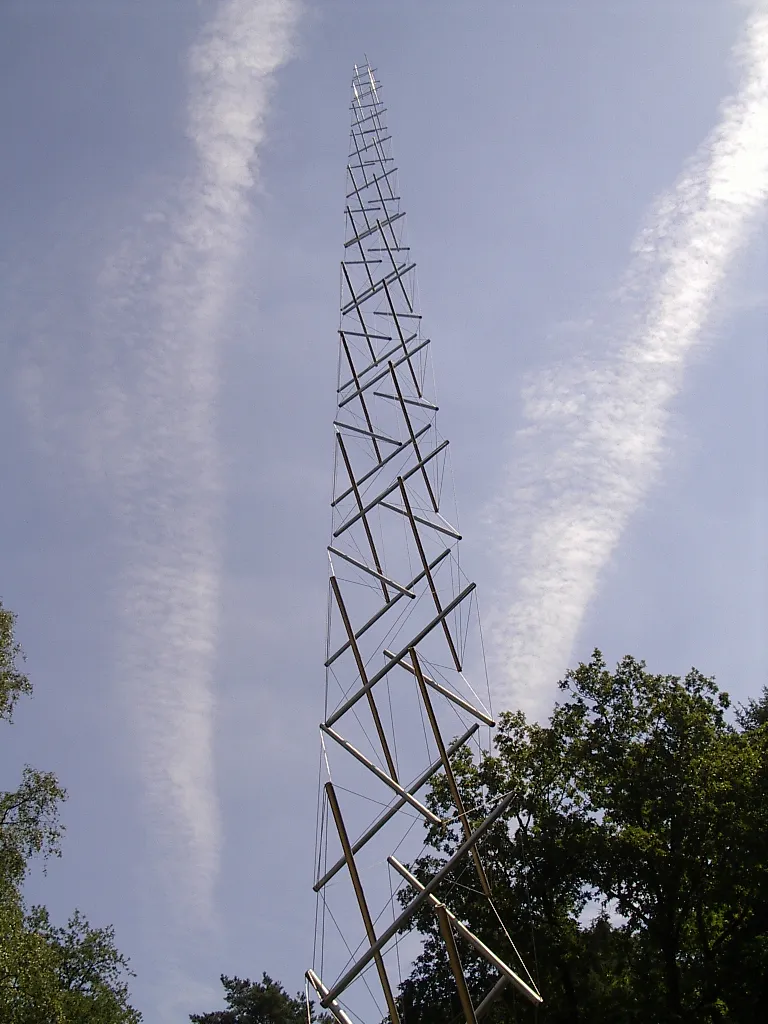
A genuine tensegrity structure has continuous tension and discontinuous compression. In plain English: the cables, ropes or tendons form an unbroken web of pulling forces, while the rigid struts are isolated from one another. The struts do not touch. They float in a pre-stressed net. The structure holds its shape because the tension and compression are balanced, not because a hidden steel post is doing the real work.
That is a specific, elegant and quite demanding condition. It is not a synonym for 'looks light', 'uses cables' or 'was hard to model in CAD'. Tensegrity is a way of arranging forces. It is not a promise of infinite strength, and it is certainly not a promise that a domestic roof will stay up without ordinary walls, beams or foundations.
Cable-stayed is not the same animal
Most of the tensile structures you see in British towns are not tensegrity. A cable-stayed footbridge uses cables to support a deck, but its compression path is continuous through the pylon and deck. A tent uses tensioned fabric, but its poles are usually in continuous contact with the ground and each other. A suspension bridge is a magnificent thing, but it is not a tensegrity framework. These structures may be lighter, cheaper or more elegant than a tensegrity equivalent — they are simply different.
The confusion matters because 'tensegrity' sells. A regeneration brochure can make a perfectly ordinary cable net sound like a scientific breakthrough by adding the word. A public-art proposal can promise a floating sculpture and then quietly add a stainless-steel support column at the back. Neither is necessarily dishonest, but both should be labelled honestly. If the compression members are bolted together, it is a frame with pretty cables. That is fine. Just do not call it tensegrity.
Claims to treat with caution
Watch for phrases like 'tensegrity-inspired', 'zero-compression' and 'floating on air'. Inspiration is allowed; vagueness is not. Ask what is doing the compressing, what is doing the pulling, and what happens when the pulling stops. A structure that collapses if one cable is cut may still be safe and well designed, but the public deserves to know that the cables are load-bearing, not decorative.
Commissioners should also ask for a force diagram, not just a render. A beautiful image of a floating canopy tells you nothing about wind uplift, snow load or the cost of maintaining turnbuckles in a wet British climate. If the artist's statement uses 'tension' as a metaphor for social cohesion, that is a different kind of project. It may be excellent. It is not structural tensegrity.
A plain-English checklist for commissioners
If you are judging a project in 2026, keep these questions close.
- Can you point to every compression member? Are any of them touching each other?
- Is there a continuous path of tension through cables or tendons?
- Does the structure stand only because those cables are pre-stressed?
- What happens if one cable is removed, slackens or corrodes?
- Is the word 'tensegrity' being used as engineering, or as atmosphere?
- Are hidden supports disclosed in the drawings and the interpretation panel?
- Does an engineer's name appear alongside the artist's or maker's?
If the first four answers are vague, treat 'tensegrity' as a mood-board word. That does not make the project bad. It makes the label unreliable.
Where honest tensegrity shines
Tensegrity is brilliant at small scale and in controlled conditions: sculptures, furniture, educational models, lightweight deployable structures and robotics research. It teaches force paths beautifully. It rewards careful making. It looks extraordinary when it is done properly. But it is not a universal building system, and it does not need to be. A tensegrity table is honest because it is not pretending to hold up a house.
The next time you see a press release claiming a tensegrity revolution on a UK high street, read it slowly. Ask for the force diagram. Ask where the compression lives. Ask whether the cables are structural or scenic. If the answer is 'a bit of both', that is not a scandal — it is just a hybrid structure. Hybrids are fine. Overclaiming is the thing to resist.
Tensegrity is a way of arranging forces, not a promise of infinite strength. Keep that sentence in your pocket, and you will be harder to impress in exactly the right way.