Look, No Struts: Five Tensegrity Clues for a British Weekend Walk
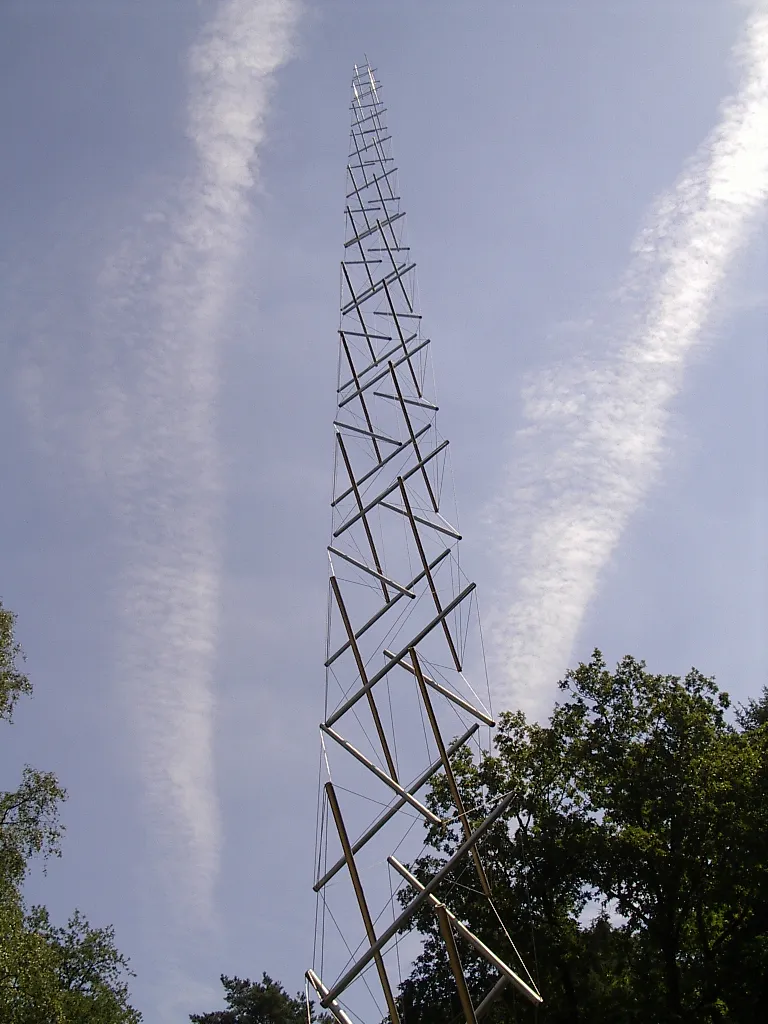
Photo: Staka, CC BY-SA 4.0, via Wikimedia Commons
A good walk in Britain is already a design safari. You pass station canopies, park sculptures, museum atriums, footbridges and the occasional optimistic café umbrella. Most of it uses tension somewhere. Very little of it is tensegrity. Learning to tell the difference is a pleasant way to slow down, look up and annoy your walking companion with the phrase 'but are the struts touching?'
Take a waterproof. This is a field guide, not a laboratory.
1. Continuous tension
Start with the cables, ropes or tendons. In a true tensegrity structure, tension runs in an unbroken web. Follow one cable with your eye and see whether it connects into a larger system of pulling forces. If the load path disappears into a bolted plate and never comes back, you may be looking at a frame with decorative cables.
Observation exercise: stand still and trace the tension path with a finger. If you lose the thread at a welded joint, note it. That joint is a clue.
2. Isolated compression
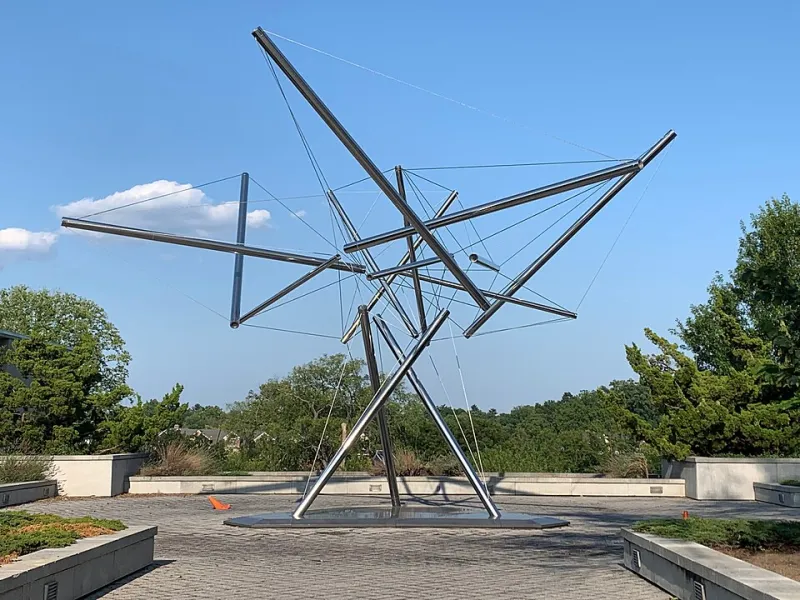
This is the great tensegrity giveaway. The rigid struts should be islands. They may be separated by air. They may touch only through cables, tendons or small pinned connections. If every strut is welded or bolted to every other strut, you are probably looking at a conventional frame.
A playground climbing frame often has continuous compression: poles meet at joints and hold each other up. That is not a criticism. It is just not tensegrity. Look for struts that seem to have no business being separate.
3. Floating members
Tensegrity often produces a floating effect: a beam, rod or platform that appears to hover, held only by thin lines. It is a wonderful sight, and it is also easy to fake. A floating shelf with hidden brackets is not tensegrity. A sign with a concealed steel post is not tensegrity. The question is not 'does it look floaty?' but 'what is actually holding it?'
Look behind the object. Look underneath. Look for the shadow of a support. Public art is allowed to use hidden armatures, but honest public art should say so.
4. Minimal contact
Tensegrity joints tend to be small, pin-like and loaded in tension or compression. They are not usually big welded nodes. Minimal contact is not proof of tensegrity, but it is a useful clue. If the joints are chunky and continuous, the structure is probably relying on bending stiffness rather than a balanced cable net.
Be careful with this one. A beautifully engineered conventional joint can be minimal too. Use it alongside the other clues, not as a verdict on its own.
5. Pre-stress
The structure should look tightened, not merely assembled. Cables are tuned like bicycle spokes or guitar strings. You may see turnbuckles, threaded rods or tensioners. If the cables are visibly slack, the structure is not doing tensegrity work in that moment. Pre-stress is what keeps the whole system stable.
Do not touch public structures or adjust tensioners. This is an observation exercise, not a maintenance workshop. If you are making your own model, pre-stress is the part that separates a wobbly pile of sticks from a structure that stands.
When it is tensile but not tensegrity
A tent is tensile. A cable-stayed footbridge is tensile. A suspension bridge is tensile. A bicycle wheel is pre-stressed. None of these is automatically tensegrity. They may use cables, and they may look light, but their compression path is continuous or their geometry works in a different way.
This is not a hierarchy. A cable-stayed bridge can be a superb piece of engineering. A tensegrity sculpture can be a fragile, fussy thing. The point is to read what is there, not to award points for vocabulary.
A five-minute observation exercise
Pick one structure per walk. Ask five questions: Where is the tension continuous? Which compression members are isolated? What appears to float? Where is the contact minimal? Can I see evidence of pre-stress? Then sketch the force paths. You do not need to be accurate. The sketch is there to make you look again.
Try it at a railway station canopy, a museum atrium, a park sculpture or a bridge. You will find tensile structures almost everywhere. Genuine tensegrity is rarer, which is part of the pleasure. When you do spot it, the floating struts will feel less like magic and more like a very good conversation between pulling and pushing.
Most impressive structures are hybrids. That is fine. The aim is not to catch anyone out. It is to walk a little more sharply, ask better questions and enjoy the quiet drama of forces doing their work.