Floating Flats and Hidden Wires: How British Stage Sets Get Away With It
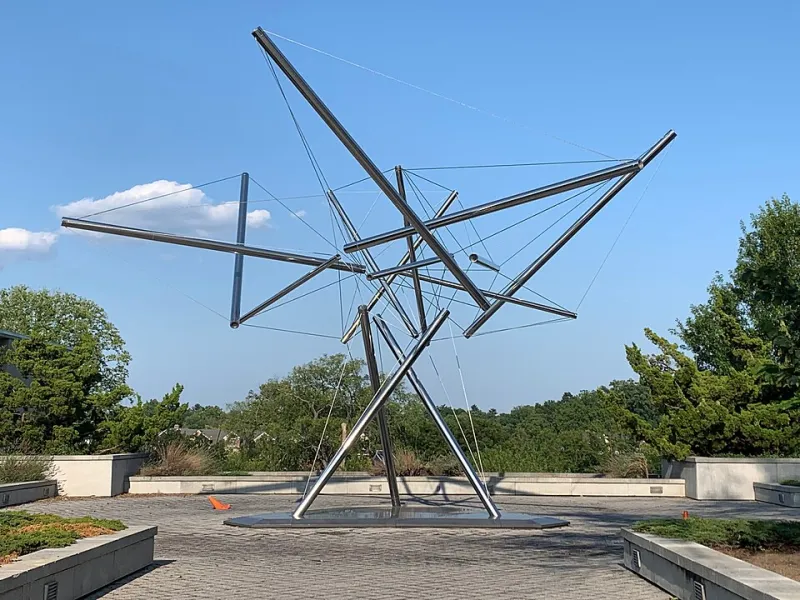
Stand at the back of a fringe venue on the third night of a run and you can usually spot the trick, if you know where to look. A flat hovering above the stage deck. A cloth that billows with no fly bar above it. A table whose legs are nowhere near the floor. Nine times out of ten there's a cable involved. Increasingly, there's a tensegrity frame doing the work.
Why designers reach for tension
The obvious driver is visual. A piece held by thin lines reads as lighter, more contemporary and frankly more magical than one propped on a fat steel leg. Directors like it because it changes how performers move — you can walk round it, under it, through it, and the set stops behaving like furniture.
The less romantic driver is logistics. Touring productions live or die on get-out time. A tensegrity set piece comes apart into struts and coils of cable in minutes and weighs almost nothing next to the rigid alternative. In a pub theatre with no fly tower and a two-hour turnaround before the van leaves, that's the entire argument.
Hiding the cables
This is where the craft lives. A few approaches that recur:
- Route tension lines along edges that already exist — the shadow of a lighting bar, the black of the masking, the vertical of a doorway.
- Use blacked-out wire rope with crimped ferrules, or dyed shock cord where a bit of give is acceptable. Nylon catches light and greys with dust; swap it out before opening night.
- Terminate to the grid or to a plate under the deck, never to anything a performer could catch a foot on.
- Do the tensioning backstage with turnbuckles, and mark the setting so it goes back the same way at every venue.
- Give the eye something else to look at. Audiences notice cables on sets where nothing else is happening.
Good designers also lean on the frame's own geometry: the struts read as the design, the cables read as nothing at all.
Passing the inspection
Here's where enthusiasm meets paperwork, and where a lot of ambitious builds quietly stall.
Anything suspending a load in a UK venue will generally fall under LOLER 1998 as lifting equipment, with rigging hardware covered by PUWER 1998. A suspended scenic element is also a temporary structure, so the venue's technical manager will want load calculations, a risk assessment, method statements, and evidence that the thing has been proof-loaded and won't drop a strut on the front row.
The questions come roughly in this order. What's the total weight? What's it hung from, and is that point rated? What happens if any single cable fails? How is each termination made off? Who checks it on tour, and how often?
The single-cable-failure question is the one that sorts robust designs from merely pretty ones. A safe suspended piece fails gently: the frame settles into a catcher, the flown element lands on a stop, nothing swings into the wings. Secondary retention on every termination, and a design where losing one line means a droop rather than a collapse.
Touring maths
Touring punishes everything. Wire rope fatigues and develops meat hooks. Ferrules slip if they were swaged in a hurry. Build in spares, label every component with its position, and keep a tension log so the next venue gets the same setup as the last.
Worth remembering too: a tensegrity frame in a cold load-in bay behaves differently from one sitting under stage lighting for three hours. Aluminium struts expand and synthetic cable creeps, both of which change the tune. Check it once the space has warmed up, not before.
A checklist for makers
If you're tempted to build a floating set piece, work through this before you cut anything:
- Decide what it's for — one reveal, or the whole show?
- Weigh everything honestly, hardware included.
- Find out who owns the grid before you draw a single line.
- Design for the failure of any one cable.
- Use rated hardware throughout, not whatever was in the box.
- Put secondary retention on every termination.
- Get a structural check if any part sits above head height.
- Write the method statement before the build, not after.
- Prototype at model scale, then at full size in a rehearsal room.
- Rehearse the get-out with the actual crew who'll do it.
- Log tensions and photograph settings at each venue.
- Leave a little tension in hand for after warm-up.
When not to bother
Sometimes a flown flat or a straight leg is safer, cheaper and just as convincing. Tensegrity earns its place when the floating quality is the point — when the set is meant to look like it shouldn't be standing. Otherwise you're taking on rigging risk for an effect nobody in row K will register.
Which is the same trade-off as everything else on this site: the structure looks impossible, the engineering is entirely possible, and the skill lies in knowing which of the two the audience is meant to see.