The Body Is Not a Tent: A Cautious Guide to Tensegrity in Movement Teaching
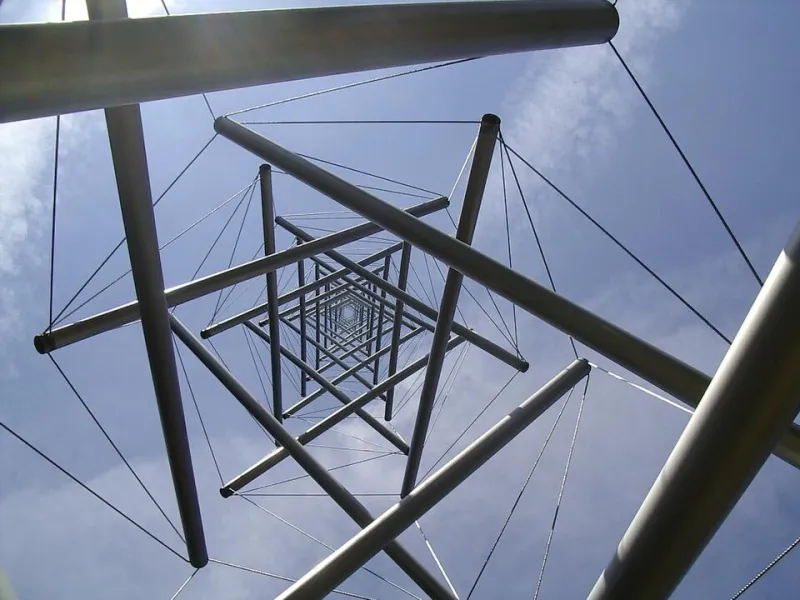
Photo: Northeastern Nomad, CC BY-SA 3.0, via Wikimedia Commons
On a wet Saturday in Sheffield, a parkrun volunteer tells me her knee feels 'out of alignment'. A yoga teacher nearby says the body is a tensegrity structure, so everything is connected. Both statements are trying to describe the same thing: a body that shares load rather than stacking it like bricks. One is everyday language. The other borrows a word from engineering. The borrow is useful, but only if we handle it carefully.
A metaphor with cables and struts
A true tensegrity structure has a very specific arrangement. Cables pull, struts push, and the whole thing is prestressed before any outside load arrives. That prestress is what gives it shape. Take a tabletop model, tighten the strings, and the frame finds a stable form. Loosen one cable and the whole thing sags. This is not mysterious. It is structural bookkeeping.
Bodies do some of this, but not all of it. Bones can take compression. Muscles, tendons and ligaments pull. Fascia and pressurised tissues distribute force. The body also bends, shears, twists and actively corrects itself with nerves and muscles. A runner's leg is not a clean cable-and-strut frame. It is a messy, adaptive system that sometimes behaves in ways that tensegrity language can illuminate.
What runners, physios and yoga teachers get right
The strongest thing movement teachers take from tensegrity is whole-system thinking. A sore knee is rarely just a knee problem. Load travels through the foot, ankle, hip and trunk. If one part stops doing its share, another part picks up the bill. That is a genuinely useful intuition, and it fits with modern physiotherapy's interest in load management rather than isolated muscle fixes.
The second useful idea is that tension is not automatically bad. In a tensegrity model, tension holds the structure together. In a body, tension is part of normal movement. The trick is not to remove all tension but to keep it varied and manageable. A runner who stiffens everything to 'stay aligned' may be reducing useful variability. A yoga teacher who encourages slow, controlled loading is often closer to good practice than one who demands a single perfect posture.
The third useful idea is resilience through distribution. Tensegrity models fail gradually because many members share the load. Bodies are not indestructible, but they do better when strength and movement are spread across a system rather than concentrated in one heroic muscle.
Where the metaphor slips
The trouble starts when the metaphor becomes a diagnosis. You will hear that bones 'float' in a sea of fascia, or that the body is a pure tensegrity net. Those claims sound elegant, but they oversimplify anatomy. Bones are not floating struts. Fascia is not a single continuous cable system. The body has joints, cartilage, blood vessels, pressure gradients and active neural control. It also has bending and shear, which classic tensegrity models do not handle neatly.
Biotensegrity, the term often used for tensegrity-inspired biology, is a model rather than a settled fact. It can prompt good questions: where is the load going? What is under tension? What is under compression? But it should not be used to explain every ache or to sell a treatment. If someone tells you they can diagnose a 'tensegrity imbalance' and fix it with a particular stretch, ask for evidence. In the UK, NHS physiotherapy and qualified sports medicine practitioners are better placed to assess pain than a metaphor, however elegant.
Practical takeaways for students, makers and movers
If you are a design student in Leeds or a maker in Bristol, build a small tensegrity model before you use the word in a project. Feel the prestress. Notice how one slack cable changes everything. That experience will make you more careful when you apply the idea to a body, a chair or a bridge.
If you teach movement, use tensegrity as a prompt, not a proof. Say 'this borrows from tensegrity' rather than 'the body is tensegrity'. Ask students to notice where they feel tension and where they feel compression. Encourage varied loading, gradual progression and recovery. For runners, that might mean strength work, easy days and a sensible return after injury. For anyone in pain, it means seeing a qualified professional rather than self-diagnosing a structural story.
If you are simply curious, keep the engineering idea in your pocket. It is a lovely way to think about how parts hold each other up. It is not a replacement for anatomy, physiology or clinical evidence. The body is not a tent. It is something stranger and more interesting: a living system that uses tension, compression, movement and control in ways no tabletop model can fully capture.
A calmer way to think about it
The tensegrity metaphor earns its place when it makes us ask better questions. It fails when it makes us certain too quickly. Use it to notice load sharing, to appreciate prestress and to avoid rigid thinking. Then put it back on the shelf before it starts pretending to be a medical degree.