No Backbone, No Problem? What a Floating Cycle Rack Did on a Yorkshire Towpath
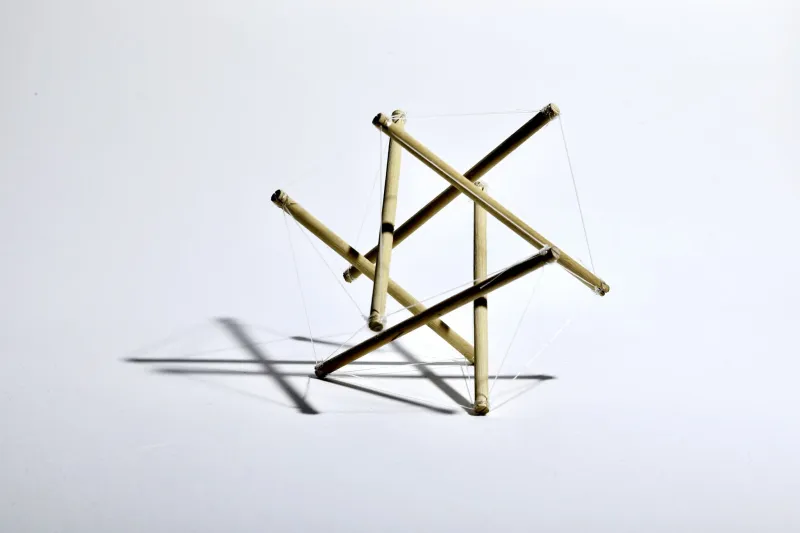
Photo: tensegrity bicycle rack prototype stainless steel cables canal towpath UK, via mymodernmet.com
The first thing people do when they see a tensegrity bike rack is try to push it over. That is not a design flaw. It is a design brief.
Over the summer of 2026 we built a prototype cycle stand on a West Yorkshire canal towpath, a few minutes' walk from a busy station. It was not a product launch. It was a field test. The question was simple: can a rack that looks like it is floating survive the way British public furniture actually gets used?
Why make a bike rack float?
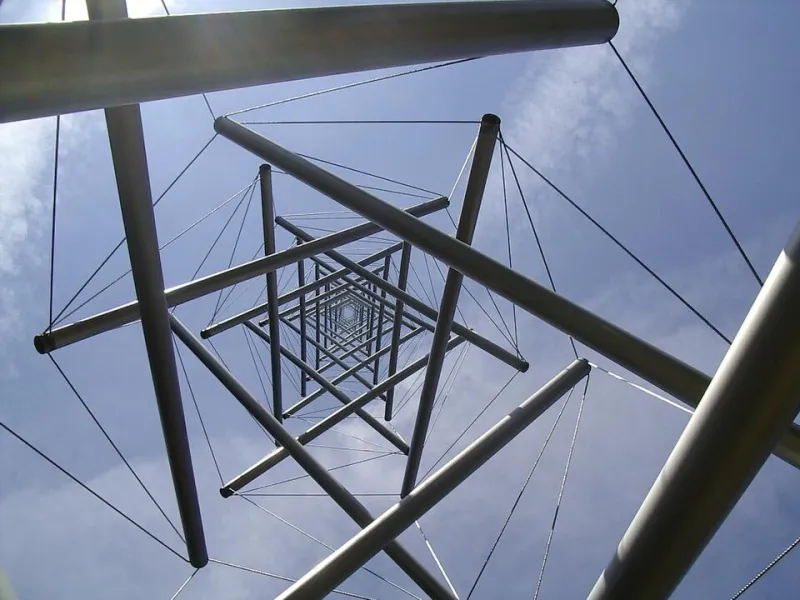
A standard Sheffield stand is a bent steel hoop. It is cheap, legible and almost impossible to break. It is also visually heavy. A tensegrity rack replaces the hoop with a top rail held above a base frame by a network of cables in tension and struts in compression. The rail appears to hover. The structure looks light enough to lift with one hand.
That visual lightness is the whole point. Cycle parking is often squeezed onto pavements beside bins and bollards. A rack that reads as a piece of design rather than a lump of tubing might earn its place in sensitive locations: station forecourts, canal-side squares, the edges of parks. But only if it can take the knocks.
The load path is a conversation, not a shelf
A bike rack has a simple job: stop a bike falling over while someone locks it. The loads are not simple. A parked bike leans. A rider arriving in a hurry shoves the frame. A child climbs on the top rail. A thief yanks at a D-lock. Wind pushes on a bike cover like a sail.
In a tensegrity rack, those forces travel through the top rail into the cables, down into the base frame and out through the anchors. The struts push back. If the cables lose tension, the geometry goes soft. If one cable is cut, the rack may collapse. That is the trade-off: visual lightness bought with a structure that needs pretension and a fail-safe plan.
Our prototype used 8mm stainless cables, swaged fittings and turnbuckles under removable caps. The base was bolted to a concrete plinth beside the towpath. On paper, the numbers worked. On site, the first lesson was that a bike is not a static load. It is a small, awkward lever with a lock attached.
Cables are the weak point, and the interesting bit
Cables are excellent at pulling. They are less excellent at being dragged through grit, kicked by boots and sprayed with canal water. Every guide, every turnbuckle and every swaged end is a place where wear can start. Our guide nearest the ground collected a paste of towpath grit and chain oil within a fortnight. We added a sacrificial sleeve, but that is a maintenance item, not a fix.
Then there is security. A thief cannot easily cut a thick steel hoop. A cable is a different proposition. If someone cuts a cable, the rack may drop and the bike may fall. The bike is still locked, but the rack is now a hazard. A public version would need either guarded cables, a hidden secondary frame, or a design that fails in a predictable, safe way. That last option is the most promising, and the least glamorous.
Rain, grit and the British towpath
British public furniture lives in a wet, gritty, salty world. Towpaths flood. Gritters throw salt. Pavements get swept by machines that do not care about turnbuckles. Our prototype survived six weeks, but it needed re-tensioning after two. One cable guide showed visible wear. The base plate trapped a shallow puddle.
None of that is fatal. It is a list of details. The problem is that details cost money and attention. A rack that needs a specialist inspection every month will not be maintained by a council with a stretched highways budget. A rack that can be checked with a spanner and a visual glance has a chance. A rack that needs a tension gauge and a trained eye is a liability.
What the prototype actually revealed
People noticed it. That sounds trivial, but it matters. Several passers-by stopped to ask how it stood up. One tried to lift the top rail. Another locked a bike to a cable rather than the rail, which is exactly the wrong thing to do. Without clear signage, a floating rack invites experimentation.
It also worked. Bikes parked. Locks locked. The rack held a loaded cargo bike for an afternoon. But the experiment confirmed the gap between a prototype and infrastructure. A maker can babysit a rack for six weeks. A council needs it to survive six years, with a maintenance schedule that fits on one side of A4.
The public realm test that matters
The realistic home for a tensegrity cycle rack in 2026 is not the high street. It is supervised, lower-risk space: an office courtyard, a school campus, a festival site, a private towpath garden. Those places can accept a structure that asks to be looked after. They can also use it as a talking point.
For the public highway, the design needs to become boring in the right ways. Standard anchors. Standard cables. A secondary safety system. A maintenance hatch that does not need a specialist. Clear instructions that say lock to the rail, not the cables. Until then, the floating rack remains a brilliant demonstration of tension and a mediocre piece of street furniture.
That is not a failure. It is a useful result. Tensegrity teaches us that stability comes from balance, not bulk. British streets teach us that balance needs maintenance. The next prototype should be designed for the second lesson first.