Gauging the Give: Could a Tensegrity Mast Survive a British Flood Season?
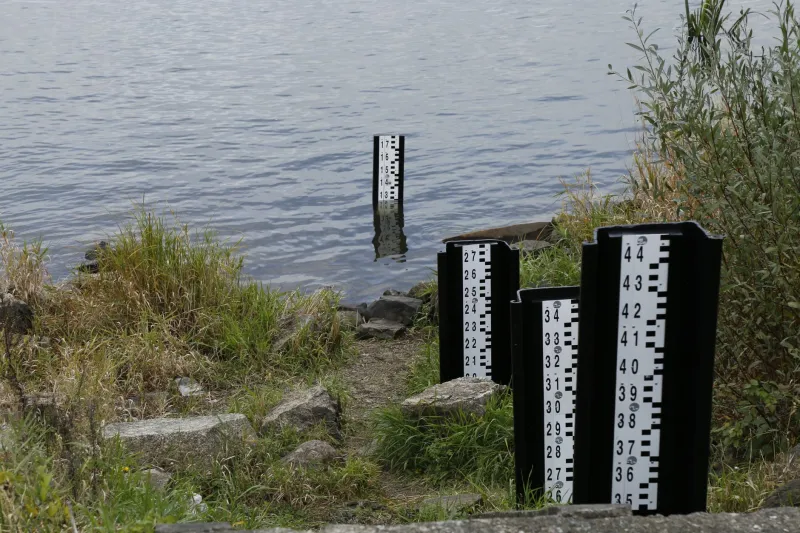
There is a particular kind of British river gauge that looks almost apologetic: a slim pole, a small box, a solar panel the size of a paperback. It stands in the margins of the Ouse or the Calder, quietly logging how much water is heading downstream. Most of the year it is ignored. In November, when the rain settles in and the floodplain starts to fill, it becomes one of the most useful objects in the valley.
That is also when it takes a beating. Fast water carries branches, gravel and the occasional wheelie bin. The pole vibrates. The bank erodes. Access routes turn to soup. So when someone suggests mounting the sensor on a tensegrity mast — a structure held together by cables in tension and struts in compression — the obvious question is not “would it look good?” but “would it still be standing, and still be readable, after a fortnight of filth?”
What a river gauge actually endures
A river gauge is not just measuring height. Depending on the site, it may be logging pressure, velocity, turbidity or rainfall, and sending that data to a telemetry system used by the Environment Agency, Natural Resources Wales, SEPA or a local flood group. The instrument needs a stable reference point. If the sensor head moves, the readings drift. If the pole bends, the datum shifts. If the cable is torn away, the site goes dark.
The forces are messy rather than dramatic. A rigid mast is good at holding a fixed position, but it also transmits sharp loads straight into its base and fixings. Debris strikes the pole and the whole assembly rings like a tuning fork. Bedload — the gravel and stones rolling along the riverbed — scours the foundation. A gauge that survives one big flood may still be loosened by a hundred small knocks.
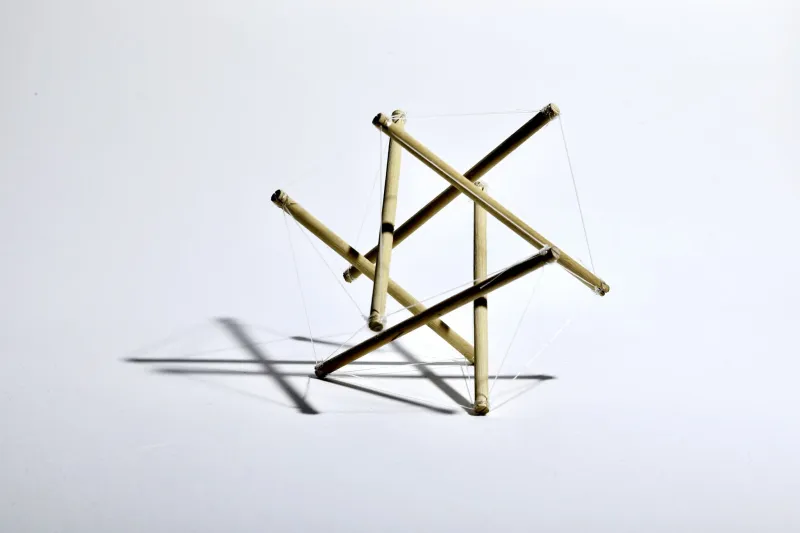
That is the gap a tensegrity mast is trying to fill. Instead of one stiff pole, you get a structure where separate struts push against each other while a network of cables pulls the whole thing into shape. The sensor platform can be isolated from the worst of the shock. The mast can flex, recover and keep the instrument level. In theory, at least.
The tensegrity pitch: isolation without a rigid box
A tensegrity mast is not a wobbly pole. It is a carefully tuned system. The struts are in compression; the cables are in tension. Nothing touches except through that balance. Change one cable tension and the whole structure’s behaviour changes. That is the appeal for a river gauge: you can put the sensor on a platform that is mechanically separated from the base, so a knock at the bottom does not arrive at the top as a jolt.
It is also the catch. A conventional steel pole is boring in the best way. You can inspect it with a clipboard and a pair of binoculars. A tensegrity mast asks more of its minders. Cables can slacken. Connections can corrode. A single missing pre-tension can turn a precise structure into a floppy one. On a floodplain, where maintenance windows are short and the weather is usually doing something unfriendly, that matters.
The honest pitch is not “maintenance-free”. It is “maintenance-aware”. A well-designed tensegrity mast could make the sensor head easier to isolate, easier to swap and less likely to be shaken loose by debris. But it would need to be designed for inspection from the start, not as an afterthought.
Three tests before a floodplain trial
If a UK monitoring team were asked to consider a tensegrity gauge mast in 2026, they would probably want three kinds of evidence before letting it near a real river.
First, shake testing. Not a gentle wobble on a lab bench, but a controlled programme of vibration and repeated shock, ideally side-by-side with a conventional mast. The question is not whether the tensegrity mast moves — it will — but whether the sensor head returns to the same position and keeps producing comparable data.
Second, debris impact testing. A river in spate does not deliver clean, predictable loads. It delivers branches at odd angles, often underwater. A test rig could fire weighted timber at the mast and log what happens to the platform. Does the structure absorb the hit, or does it store the energy and release it later? Does a cable go slack? Can the mast still be read from the bank?
Third, a serviceability trial. This is the unglamorous one. Can a technician in waders check the cable tensions in ten minutes? Can they replace a strut without dismantling the whole mast? Are the connections reachable when the bank is slippery? If the answer is no, the structure may be elegant but impractical.
The inspection problem
Tensegrity structures have a visual honesty that is appealing: you can often see the load path. But visible cables are not the same as simple cables. A conventional pole gives you a clear yes or no — straight, bent, rusted, gone. A tensegrity mast gives you a pattern. Is that cable meant to be that slack? Is that strut sitting at the right angle? Has the whole assembly twisted slightly since the last visit?
That is why any serious trial would need a baseline record: photographs, tension measurements and a simple pass/fail checklist. It would also need a fail-safe plan. If a cable is lost in a flood, does the sensor stay above the waterline? Does the mast collapse into the channel, or does it fold into a known safe shape? These are the questions that turn a neat idea into something a flood authority can actually specify.
Where it might fit — and where it won’t
A tensegrity mast is unlikely to replace every river gauge in Britain, and it should not try. On a small, sheltered stream with easy access, a conventional pole is cheaper and simpler. On a large tidal river with heavy debris and fast currents, the maintenance burden may be too high. The interesting middle ground is the exposed floodplain site: a place where vibration, bank erosion and occasional impacts are real problems, but where a modular mast could be inspected and repaired between events.
There is also a public-realm angle. River gauges are part of the quiet infrastructure of flood resilience, and they are increasingly visible to walkers, anglers and citizen scientists. A mast that is easy to read, easy to photograph and easy to explain might have value beyond the data. It could show how a structure gives under load without giving up — which is, after all, the tensegrity story in one sentence.
What would make a monitoring team say yes
The answer is not a flashy demonstration. It is a dull, well-documented year. A side-by-side trial. Comparable data. A maintenance log. A clear answer to the question “what happens when a cable fails?” And a cost case that includes the whole life of the asset, not just the first installation.
British rivers will keep testing their banks, their bridges and their instruments. A tensegrity gauge mast is not a miracle solution, and it should not be sold as one. But as a way to isolate a sensor from the worst of the knocks, while keeping the structure open to inspection, it is worth a serious field trial. The flood will ask the questions soon enough.