Grippers That Give: Inside the UK Robotics Labs Betting on Wobbly Frames
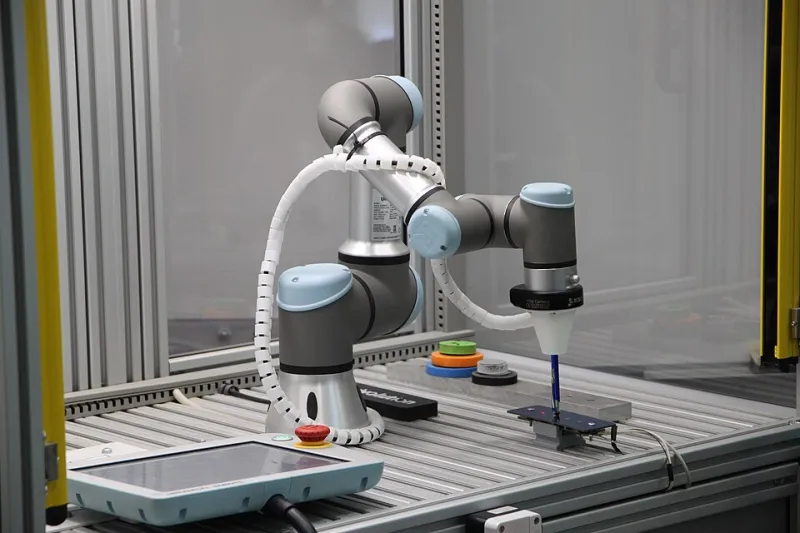
Photo: Caio.st.oliveira, CC BY-SA 4.0, via Wikimedia Commons
There's a moment in every tensegrity demo when someone leans on the top of the frame, lets go, and the whole thing wobbles back into shape as if nothing happened. It looks like a party trick. It's also the reason a small number of UK robotics groups keep returning to these frames when a stiff aluminium arm would be cheaper and easier to control.
Prestress, without the mystique
Every tensegrity structure is a negotiation. Struts push outwards, cables pull inwards, and the members only meet at the points where the cables terminate. Prestress is the tension you build in before the machine lifts a finger — the baseline pull that stops the whole assembly from being a bag of loose sticks.
For a machine, that buys a few specific things. Stiffness without solidity: tighten the cables and the frame firms up, but it never becomes a rigid lump, so a knock gets absorbed rather than passed straight into a gearbox. Stored return force: a displaced tensegrity frame wants to come home, which is free actuation for anything that repeats. And mass — cables are lighter than beams, and you can sling the heavy parts low and central, where they help rather than hinder.
What prestress does not buy is accuracy. Ask anyone who has tried to command a floppy structure to a millimetre.
Grippers: the honest entry point
Compliant grippers are where tensegrity robotics stops being a metaphor and starts being a build. The appeal is simple: a gripper that gives a little can pick up a tomato, a lightbulb and a mug without a sensor telling it which is which. Cable-driven fingers on a tensioned frame behave a bit like a hand that knows when to stop squeezing.
Most of what appears in journals is still a bench demo — a rig, an overhead camera, a script running the same motion two hundred times. But the barrier to a workshop version is lower than people assume. Silicone or TPU fingers, a handful of 3D-printed struts, braided line as cable, hobby servos with current sensing to spot when the pull has gone far enough. That's a weekend, not a doctorate.
The UK side of this is genuinely strong. Robotics groups around Bristol, Edinburgh, Imperial and Sheffield have spent years on soft and compliant manipulation, and the parts supply chain — servo, silicone, tension line — is basically a good hobby shop plus a decent printer.
Crawling: where it gets hard
Crawling tensegrity robots are the demos that get the video views and the ones that flatter the concept least. They bounce, they roll, they shrug off drops that would kill a normal chassis. Then you try to steer one.
The trouble is control. A tensegrity frame has more degrees of freedom than actuators, so the machine's shape is only loosely related to what you commanded. Researchers get round this by measuring cable tension or motor current and treating it as a crude sense of touch — proprioception through the back door. It works, sort of. It is slow, and payload is pitiful.
If you want one on the bench, expect a robot that shuffles and needs endless tuning. Enjoy it for what it is: a study in robustness, not a delivery vehicle.
Exoskeletons: promising, awkward
Wearables are where the engineering gets socially complicated. A tensioned frame can be light, can sit close to the body, and can push assistance where it's wanted without a scaffolding of rigid links. Groups working on soft exosuits have leaned on cable tension for exactly this reason.
The catch is the human. Donning time, comfort, heat, and the plain fact that a cable under tension near a limb is a safety question rather than a design preference. Anything worn has to fail gracefully — a slack line, never a snapping one.
Bench-ready or paper-ready?
A rough sorting, from a maker's point of view:
- Compliant cable grippers — bench-ready now, with cheap parts and forgiving tolerances.
- Small crawling frames — possible at home, but budget months of fussing and a robot with opinions.
- Wearable assistance — not a garage project. The mechanics are approachable; the safety case is not.
- Anything claiming precise positioning — treat with polite scepticism until you've seen the repeatability figures.
Starting points close to home
Hackspaces and university maker facilities are the obvious first call, and several UK robotics departments run open days where you can handle the hardware rather than squint at a render. The Institution of Engineering and Technology and the Institution of Mechanical Engineers both publish accessible introductions to compliant mechanisms, and there's a growing stack of open-source designs for cable-driven grippers that will get you to a working prototype without reinventing the finger.
The thing to internalise is that tensegrity isn't a shortcut to a better robot. It's a different bargain — forgiveness in exchange for precision, lightness in exchange for control complexity. Once you know which side of that bargain your project sits on, the wobbly frame stops being a curiosity and starts being the sensible choice.