The Quiet Stand: What UK Audio Makers Are Learning from Tensegrity Speaker Platforms
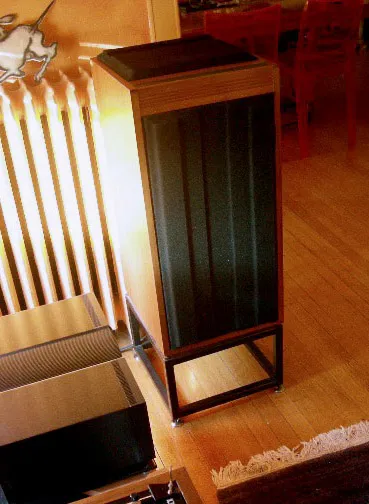
Photo: kuma, CC BY-SA 3.0, via Wikimedia Commons
Hi-fi furniture is usually asked to do one job: hold a speaker at the right height and stay out of the way. A tensegrity speaker stand asks for more attention. It turns the support into a visible network of struts and tensioned cables, with the speaker apparently floating above a base. In small UK audio workshops and one-person maker spaces, that mix of engineering and theatre is proving hard to resist.
The appeal is easy to understand. A speaker cabinet moves when its drivers move. Some of that motion is useful; some of it travels into the stand, the floor and the room. A tensegrity platform seems to offer a way to interrupt that path while making the whole setup look less like a black box on a shelf. But does the structure actually improve the sound, or does it simply look as if it should?
What the stand is really doing
A tensegrity stand is not floating in defiance of physics. It is a closed force system: compression elements push, tension elements pull, and the platform sits in a balance of loads. For a speaker stand, the useful question is not ‘is it tensegrity?’ but ‘what kind of mechanical connection does it create between the cabinet and the floor?’
That connection can be stiff, compliant or somewhere in between, and it can behave differently in different directions. A cable network may be very stiff in tension but allow small rocking movements. A platform may be stable vertically but less so side to side. Those differences matter because speaker cabinets generate forces in several directions, not just up and down.
There is also a common confusion between isolation and coupling. Isolation aims to reduce vibration travelling from the speaker into the floor or furniture. Coupling aims to hold the cabinet firmly so it cannot rock. A tensegrity stand can be designed for either, but not automatically for both. A wobbly stand is not necessarily an isolating stand, and a rigid stand is not automatically a bad one.
Testing the claims without the hi-fi mystique
The claims around speaker stands tend to arrive in familiar language: tighter bass, clearer mids, a quieter background. Some of these differences can be real, but they are often small and room-dependent. In a typical British living room, the distance to the rear wall, the floor covering and the sofa will usually shape the sound more than the stand does.
A sensible maker’s test is to separate the mechanical question from the listening question. First, measure. A cheap accelerometer, or even a phone with a suitable app used carefully, can compare cabinet vibration and floor vibration with the speaker on a rigid stand, on a compliant isolation pad and on the tensegrity platform. A tap test on the platform can reveal resonances. A slow sine sweep can show whether the structure adds a noticeable peak or rattle.
Then listen, ideally without knowing which stand is in use. Ask someone else to swap the speakers while you stay out of the room. Short comparisons are more reliable than long sessions, and a familiar recording is more useful than an audiophile demonstration track. If the difference disappears when the swap is hidden, that is useful information too.
What should you expect? A well-designed tensegrity platform may reduce structure-borne vibration at some frequencies and add a little damping. It may also introduce new resonances if the cables are too slack, the struts are too thin or the platform is too light. The engineering claim is not that tensegrity sounds better. It is that a tensegrity structure can be tuned to behave in a particular way, and that behaviour can be measured.
Cables, strain relief and the hidden structural member
Speaker cables are the most common weak point in home-built tensegrity stands. A cable that hangs neatly from the platform to the amplifier looks harmless, but if it is tight it becomes an unintended tension member. It can pull the platform off-centre, couple it to the floor and change the tuning of the whole structure.
The fix is not complicated: leave a service loop. Fix the cable to the platform with a clip or strain-relief clamp, then allow a gentle slack curve before securing it to the base or routeing it away. The cable should not cross a tension element under load, and it should not be used to correct a lean. Route signal and mains cables separately where possible, and keep mains leads away from the delicate cable network so that a knock does not turn into a tug.
Cable weight also matters. A heavy connector hanging off one side of a light platform can unbalance it. Route cables as symmetrically as you can, or add a small counterweight if the design needs it. None of this is glamorous, but it is the difference between a stand that behaves predictably and one that drifts out of tune every time someone moves the amplifier.
Stability, pets and the British living room
A tensegrity speaker stand raises the centre of mass and narrows the effective base. That is a recipe for tipping if the design is treated as a sculpture first and a piece of furniture second. British homes add their own tests: uneven floorboards, deep carpet, a bay window, a radiator, a cat with a reliable sense of timing and a vacuum cleaner that arrives without warning.
Build in a low, heavy base and include levelling feet. Use rated tension elements and proper terminations rather than decorative cable and knots. Check the bucking margin on compression struts, especially if they are slender. Test with a dummy load before trusting a real speaker, and give the platform a gentle push in several directions. It should return to rest without a permanent lean or a creak.
Cable creep is another quiet issue. Tensioned cables can stretch over time, especially synthetic ones. Check tension after the first week, then monthly for a while. If the platform has moved, retune it rather than tightening everything indiscriminately. The aim is a stable balance, not a guitar string.
A practical checklist for 2026 builds
Before you cut metal or order cable, work through the basics:
- Define the load, including the speaker’s mass and a sensible allowance for dynamic movement.
- Choose compression elements with a clear buckling margin, not just enough strength.
- Use rated tension elements, turnbuckles and terminations; avoid mystery hardware.
- Design a base with a low centre of gravity and adjustable feet.
- Decide whether you want isolation, coupling or a tuned combination, and test for it.
- Leave a cable service loop and strain-relieve both ends.
- Check stability with a dummy load before fitting the speaker.
- Measure before and after, and listen blind if you can.
- Inspect tension and terminations regularly, especially in the first month.
None of this makes tensegrity speaker stands a miracle cure for room acoustics. It does make them a genuinely interesting design problem. The best British examples are likely to be the ones that treat the stand as a structure, a piece of furniture and a cable-management system at the same time. Get those three right and the platform may earn its place in the room — not because it floats, but because it behaves.